Subscribe to our newsletter
Copyright © 2026 lmitac.com All Rights Reserved. Contact - Terms and Conditions - Privacy Policy - Quality Policy - Vacancies - Sitemap
London Maritime Academy is a trade name for London Premier Group
version: 2.9.0
Subscribe to our newsletter
Posted On: 12/12/2025, 8:34:56 AM
Last Update: 12/12/2025, 8:34:56 AM
At Marintec China 2025, Modern Amperex Electric Vessel (CAEV), a division of Chinese battery company CATL, unveiled what it claims is the first and only “ship-shore-cloud” zero-carbon shipping and integrated smart port system in the world.
After noticing that electric ships need technology designed especially for marine circumstances, CAEV developed the solution.
According to CATL, electric ships cannot simply adopt technologies designed for land-based applications because of the high humidity, exposure to salt spray, long routes, and high-power requirements that warships must contend with.
The business also brought attention to long-standing industry issues brought on by the conventional paradigm, which assigns different vendors to handle power supply, energy replenishment, and maintenance.
According to CATL, this has frequently led to ambiguous responsibility and coordination issues, which have slowed the advancement of zero-carbon shipping.
Through the corporation, Su Yiyi, General Manager of CATL's Electric Vessel Department and CAEV, stated that recurring operational problems have resulted from a lack of unified accountability throughout a vessel's 30-year service life.
Additionally, Su listed several structural issues that operators deal with, including high upfront expenditures, a lack of infrastructure for energy replenishment, range anxiety, complicated water conditions, and non-standardised technology.
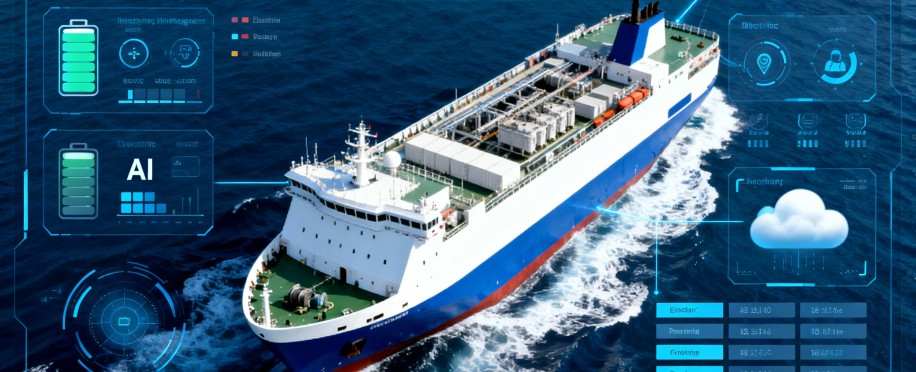
Notably, the recently introduced Ship-Shore-Cloud concept is an integrated chain that encompasses all essential components of operating an electric ship. To enable stable, long-distance travel, the system integrates a battery, power, and sophisticated navigation systems on board.
Students at London's Maritime Safety Courses learn about the 'Ship-Shore-Cloud' (SSC) system, which combines boats, shore-based energy infrastructure, and cloud administration to enable zero-carbon marine transportation. This system is investigated using a multidisciplinary approach that combines energy systems, alternative propulsion, intelligent navigation, and ship design.

Under the “separation of ship and battery” idea, CATL is advocating charging and battery-swapping facilities on the shore to ease financial pressures and allay worries about energy supply.
Moreover, vessels are connected to the Beichen intelligent navigation system and the Yunfan intelligent management platform on the cloud, allowing for remote scheduling, monitoring, and operational optimisation.
Almost 900 electric ships have already been delivered by CATL and CAEV, and since joining the zero-carbon marine business, the company has achieved numerous firsts.
These include Changjiangsanxia 1, the largest-capacity all-electric inland passenger ship in the world; Yujian 77, China's first all-electric seagoing passenger ship as certified by the China Classification Society; Qinggang Tug 1, China's first hybrid tug; and Jining 6006, the nation's first cargo-ship battery-swapping demonstration project that was delivered as a complete system and functions independently.
Furthermore, the world's five major ship classification societies have approved CATL's battery systems, energy-management tools, and associated hardware and software.
In essence, according to CATL, the Ship-Shore-Cloud solution aims to assist the growth of zero-carbon waterborne transportation by providing a full-chain approach to maritime electrification by connecting ships, shore facilities, and cloud platforms in a unified system.


