
Posted On: 12/5/2025, 10:18:42 PM
Last Update: 12/5/2025, 10:18:42 PM
As more sectors of the shipping industry adopt wind-assisted propulsion, Norsepower reports that it has signed its first contract for newbuild VLCCs and its first newbuilds in Japan.
More precisely, the company offers an updated, data-driven version of the century-old Fletter rotor, a revolving cylinder that reduces engine power and fuel consumption by using the Magnus Effect to create a propelling force.
In an effort to improve efficiency and lower emissions, Idemitsu Tanker Co., Ltd., the shipping division of Idemitsu Kosan, which claims to have one of the biggest fleets of tankers in the world, has been creating a next-generation design.
In addition to other managed ships, the company has over a dozen VLCCs on charter. The idea takes into account the boats' efficiency and gets them ready for low-carbon fuels like methanol in the future.
According to Norsepower, it inked a historic agreement with the tanker company to install its wind-assisted propulsion technology. Japan Marine United Corporation (JMU) and Nihon Shipyard Co. will construct the ships.
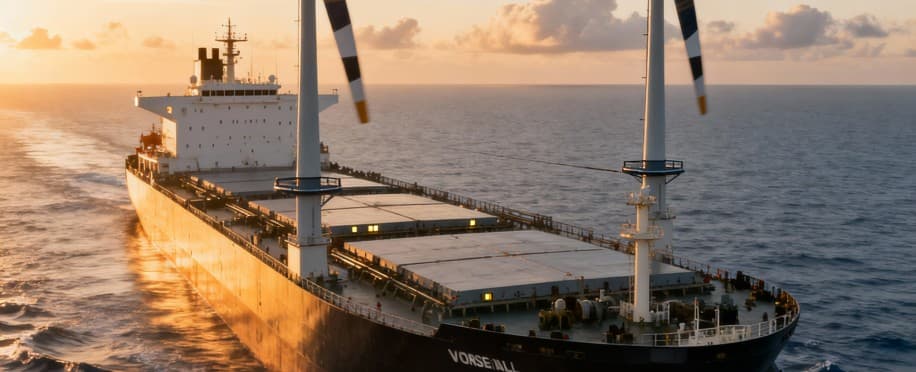
Remarkably, two explosion-proof Norsepower Rotor Sails measuring 35 by 5 meters (115 by 16.5 feet) will be included with each. By the end of 2028, the first ship is expected to be delivered.
Idemitsu Tankers stated, “By equipping our new VLCCs with the Norsepower Rotor Sail™, we are not only investing in fuel savings and emission reductions but also taking a decisive step towards the decarbonisation of long-haul shipping.”

Norsepower claims that the experiment shows how incorporating data-driven, intelligent rotor sails onto specially built vessels can result in remarkable performance improvements.
At the Maritime Training Online Courses, we train wind turbine technicians, off-site personnel, and operating teams. We increase your wind turbine competence by tailoring the training to your specific demands and data. Wind turbine optimisation, wind power services, and on-site or online.
According to the business, Norsepower Rotor Sails usually lower fuel consumption by 5–25 per cent, and even more when conditions are favourable, depending on wind patterns, routing, and vessel operations.
Furthermore, modern digital control systems that maximise performance in real time support the installation. Norsepowe asserts that it guarantees the sails run as efficiently as possible under all circumstances. The technology reduces pollution and fuel consumption by lowering dependency on engines.
Last but not least, Norsepower had discovered a lot of interest in the tanker market due to the maturity of wind propulsion. With its systems placed aboard tankers ranging from tiny chemical tankers to LCO carriers, MR, LR, VLGC, and now, for the first time, VLCCs, it claims to have 22 units operating in this market.
